How long does it take to learn Python? The honest answer
Written Sep 24, 2026
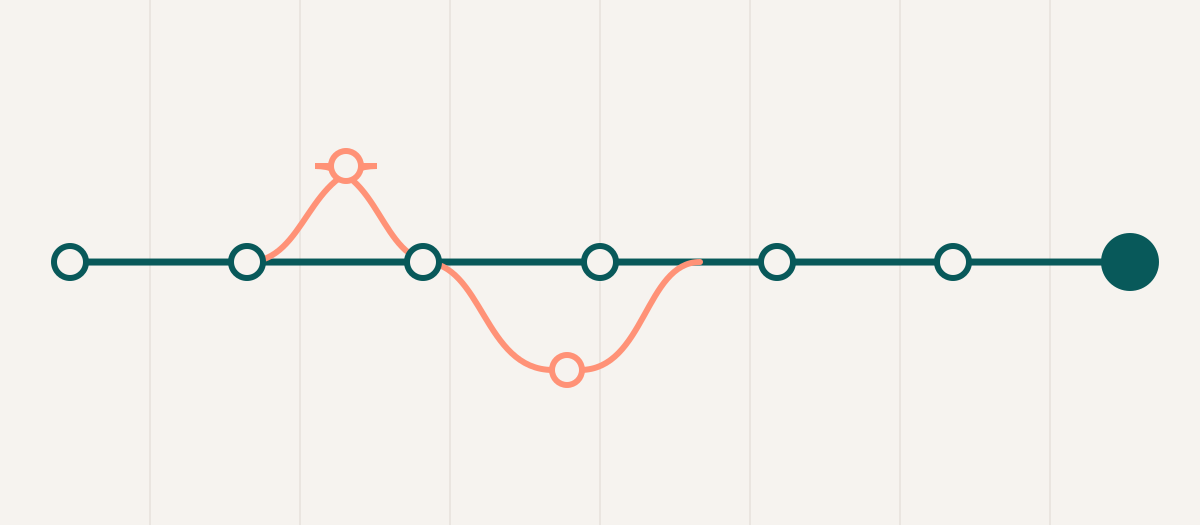
Nobody can tell you how long it will take you to learn Python, and the confident numbers you have read were made up. That is the whole answer, and the rest of this page is about what can be said instead, which turns out to be more useful.
Search this question and you will be given ranges — a few weeks to basics, some months to job-ready — presented with the calm authority of measurement. Follow one back to its source and there is never a study, a survey or a dataset at the end of it. There is another article, which cites another article. The numbers are folklore that has been repeated until it sounds like data.
What can honestly be measured: the size of the course
A course cannot know your schedule, your background or how much of your evening a toddler will claim. It does know how big it is, and several of the best ones publish that. Those figures are facts, and they are the only time-shaped numbers on this site.
- freeCodeCamp's Python certification counts 540 steps, and its own page sets the requirement as completing the five required projects to qualify for the certification exam, then passing that exam.
- CS50x describes eleven weeks of material. Python arrives in week six; the first five weeks are C, and that is deliberate.
- Python Crash Course, 3rd Edition runs to 552 pages, in two halves — fundamentals, then three projects.
Those tell you the size of the container. What they cannot tell you is how fast you pour.
The arithmetic you can actually do
Here is the sum worth doing, with your own numbers rather than ours. Take the size figure a course publishes. Decide honestly how many evenings a week you will really give it — not how many you intend to. Then track how much of the course you get through in your first fortnight, and extrapolate from that, because it is the only measurement in the whole business that is about you.
Two weeks of real data beats every published estimate, including any we could have invented. It also catches the thing the estimates never do: that progress is not linear. Everybody moves quickly through syntax and then stops dead somewhere around functions, or classes, or the first project where nothing is scaffolded.
Why the standard ranges are worse than useless
A range like "three to six months to job-ready" does two kinds of damage. If you are slower than it, you conclude you are not cut out for this, when in fact you are being measured against a number that describes nobody. If you are faster, you conclude you are finished, which you are not.
It also smuggles in a definition. "Job-ready" is not a property of a person; it is a judgement made by a particular employer about a particular role on a particular day. No course confers it, no timeline predicts it, and this site publishes no figure about it — not for Python, not for anything. That refusal is the same one we apply to salaries and completion rates, and it is set out on what this site refuses to print.
Where the time actually goes
Watch anyone learning Python and the hours do not distribute the way the syllabus implies.
Setting up, before any Python at all
Installing Python, choosing an editor, understanding what a virtual environment is and why your terminal says command not found — this eats days, and almost no estimate includes it. Browser-based courses skip it entirely, which is their real advantage and also a debt you pay later.
The lesson-to-project gap
There is a cliff between finishing exercises and building something unscaffolded. freeCodeCamp's structure walks straight into it on purpose: five required projects stand between you and the certification exam, and the first is harder than everything before it. Most of the calendar that people describe as "learning Python" is actually spent here.
Re-learning what you skimmed
Everyone skips something early — usually how functions return, or what a dictionary is for — and pays it back with interest a month later. That is not wasted time; it is how it works.
So what should you tell your friend who asked?
Something like this: you will write your first useful Python script within a fortnight if you turn up most days; you will feel genuinely dangerous somewhere in the second or third month of consistent effort; and you will still be looking things up in five years, because everybody does. None of that is a measurement, and it does not pretend to be.
If you want a plan with a shape rather than a deadline, the free six-week route through Python is the one we would give someone starting today. It costs nothing, which means a slow month costs nothing either — unlike a subscription, which bills the calendar whether you showed up or not.
The money version of this question
There is a reason "how long" matters financially, and it is worth being blunt about. Every subscription on the market charges by time, not by progress. Treehouse Courses is $25 a month; Zero To Mastery is $49 a month; Codecademy Plus is $14.99 monthly or $11.99 a month billed annually. If you are slow — and slow is normal, and usually not your fault — a monthly subscription quietly turns your life circumstances into a bill.
Which is the strongest practical argument for starting free. A free route is indifferent to how long you take. Buy time-based access once you know how fast you actually move, and you will be buying it with real information instead of an estimate somebody invented. What each route charges, and on which billing panel it admits it, lays out the alternatives with the dates we read them.
The related questions
How long does it take to learn Python?
Can I learn Python in a month?
Is it faster to learn Python with a paid course?
How long before I can get a job with Python?
Once you know what you want to learn, the money question is the same one every time: which coding courses are worth paying for, and which free route beats them sets every price we read against the routes that charge nothing.